Friday, August 27, 2010

Nail Pattern Baldness


Being a Cenobite isn't all swimming pools, movie stars, and buckets of blood. While the unsuspecting curious suffer eternal pain at his hands, Pinhead is suffering from Nail Pattern Baldness.

(Is this too far to go for a silly pun? I don't care.)

Thursday, August 26, 2010

The Regimen that Twitter Built?

I'm not a morning person. I never have been, and I never will be, in spite of the fact that my mornings start before 6:30 a.m., when my boys arrive and we kill time for an hour and 45 minutes until it's time to go to school.

And that's what we've done with that time: killed it. But no more.

I know that, if I really want to be able to call myself a writer, I need to write. (Yes, I just heard you say "duh!") I can't count the number of times I've told myself that, starting tomorrow, I'm going to start spending at least some of every morning writing.

So here, now, I'm going to make it official: Starting tomorrow, I'm going to start spending at least some of every morning writing. I will get more written, expand my blog, flesh out my story ideas, and improve my writing and my (mental) health overall.

Why the official announcement? Why now? In short, Twitter. I won't go so far as to say that Twitter changed my life, but it has strengthened my resolve. And here's how:

Since I've been on Twitter, I've connected with dozens of writers and editors, both known and obscure. (You're probably one of them!) I've followed their progress and foibles and joyous days and scraggly mornings and even rejection letters. I've also started reading blogs about writing well, teaching composition, editing messes, and the business of putting pen to paper and fingers to keyboard. And I've enjoyed it.

While I was browsing tweets and posting my own today, I realized two things in quick succession: First, because of Twitter, the blogosphere, and the Internet itself, I have found the world that I want to be a part of. Second, I realized that I'm already, to a small extent, part of that world.

Writing is by necessity is a lonely pastime, but it doesn't mean I'm on my own while I do it. At least, not anymore. I've found my peeps. Technically, they're all strangers to me because I haven't met a one of them in person. But still, they're my peeps. They're my peeps because I know I can share with them and not be judged (unless I ask them to), because I can ask them for help and get a response, and because I can give them my opinions and they will be read and considered.

So I feel like now is a great time for a writing resolution. If I can maintain just three weeks of a daily writing regimen, I can establish the habit and keep at it. And you can help: Every comment on or about this blog, regardless of what it says, is encouragement. It means someone is not only reading what I've written but giving it some thought.

To all my writing and editing tweeps: Thank you.

Tuesday, August 24, 2010

Word Subtleties: corporal vs. corporeal

First, corporal: 1) The lowest rank for a non-commissioned officer; 2) of the body; 3) a linen cloth placed at the center of the altar onto which the Eucharist is placed. Definitions 2 and 3 come to us from the Latin corpus, the body. (The Eucharist, of course, is considered the body of Christ.) Definition 1, the military rank, has a different etymology: it's linked to caput, the head, and more recently comes from the French caporal. A corporal leads (i.e., is at the head of) a corps (a body of troops).

Thus, corporal punishment, a hot-button topic when I was in school, is punishment inflicted directly to the body, e.g., spanking.

Second, corporeal: 1) Bodily, as opposed to spiritual; 2) able to be perceived by the senses, tangible.

A couple of sources indicate that corporal used to be employed in the second sense of corporeal, but that use is largely obsolete.

Setting aside military rankings, both corporal and corporeal have to do with the body, but there are subtle differences in their usage. Corporal refers to a human body of flesh and bone, as opposed to psychological or emotional. Corporeal is distinguished from spiritual and refers to a body in more abstract terms. It's often used to assign body-ness to something that doesn't usually have a body. Ghosts, shadows, and columns of smoke (especially when controlled by trickster demons) can be described as corporeal, but they certainly aren't corporal because they don't have flesh-and-bone bodies.

There are, of course, gray areas. Images of the human body have been described as both corporal and corporeal. And there is certainly an argument over what to call it when the Greek gods take human form on Earth to meddle in our business -- in one sense they are corporal forms because they are flesh-and-bone human bodies, but in another sense they are corporeal forms because they are they have a physical as opposed to a spiritual presence.

In cases like this, the decision is up to the author. Regardless of which word you choose to use, someone will disagree with you. The best you can hope for is to keep your copy editor happy by choosing one and sticking with it.

So, extending one of my examples, what would corporeal punishment look like?

Thursday, August 19, 2010

Today's Word: breve

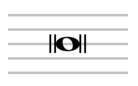
breve: In music, the breve has the longest value of any note. It's twice as long as a whole note. Because it's so long, you don't see it very often. It won't fit into most single measures, but occasionally a piece is written in a 4/2 time signature (each measure is four half notes long), and a breve fills the entire measure.

The other note values -- the quarter note, eighth note, and so on -- think the breve is a selfish, gluttonous dick. The breve is so fat, in fact, that it takes four note stems to keep it from spilling out an completely obliterating the measure!

Wednesday, August 11, 2010

Today's word: pandybat

pandybat: An instrument of corporal punishment -- noted in various places as being either a reinforced strap, a cane, or some type of over-designed paddle -- used to flog unruly students on the palms of their hands.

This is another new one for me from James Joyce's A Portrait of the Artist as a Young Man:

Stephen closed his eyes and held out in the air his trembling hand with the palm upwards. He felt the prefect of studies touch it for a moment at the fingers to straighten it and then the swish of the sleeve of the soutane as the pandybat was lifted to strike. A hot burning stinging tingling blow like the loud crack of a broken stick made his trembling hand crumple together like a leaf in the fire: and at the sound and the pain scalding tears were driven into his eyes.


From some of the other text in the book, it seems that, in more severe cases, the pandybat was used on a boy's bare bottom. I don't have any personal experience either way.

Pandybat doesn't appear in my dictionary (hopefully, its use in education has become so obsolete that the word is no longer needed), but pandy, defined as the striking of the palm of the hand as punishment, does.

Does anyone out there have any first-hand stories of being pandied? What's the worse punishment you ever received in school?

Monday, August 9, 2010

Today’s Word: Soutane, and the Last 24 Hours in Reverse

soutane: A long, close-fitting robe often worn by anglican and Roman Catholic clergy; also called a cassock. I saw soutane for the first time when I began reading James Joyce’s A Portrait of the Artist as a Young Man during dinner Monday evening. It’s there about a page-and-a-half in:

Then at the door of the castle the rector had shaken hands with his father and mother, his soutane fluttering in the breeze, and the car had driven off with his father and mother in it.

This sentence is a good example of the problem with ambiguous antecedents. If you’ve never read Portrait, you probably came away with the wrong meaning. This should help:

Then at the door of the castle the rector had shaken hands with his [Stephen’s] father and mother, his [the rector’s] soutane fluttering in the breeze, and the car had driven off with his [Stephen’s] father and mother in it.

I hadn’t originally planned to read A Portrait of the Artist as a Young Man, but when I stopped at the library on the way home, they didn’t have a copy of the book I planned to read, Pearl S. Buck’s The Good Earth, which I told my mother I would read soon.

The reason I needed a new book to read is because I finished Neil Gaiman’s The Graveyard Book Sunday night. There are few books that begin with a grisly triple murder that I would recommend for fourth- to eighth-grade kids, but this is one of them. If you have a tween who is just getting into werewolves, vampires, and ghosts (that is to say, a kid who doesn’t know what to read now that the Harry Potter series has finished), get them to start reading The Graveyard Book, and then the rest of Neil Gaiman’s repertoire.

Like he did with American Gods and Anansi Boys, Neil Gaiman gives a new, interesting, and human twist to the mythologies we think we know in The Graveyard Book. The story revolves around a child who is raised from toddlerhood by the inhabitants of an ancient cemetery after the rest of his family are eliminated during the aforementioned grisly triple murder. The boy, who is given the name Nobody Owens, grows up among the dead and learns what the dead have to teach him. Eventually, though, Nobody will have to deal with the world outside the cemetery.

As far as settings go, this is a really interesting place to start a story. Few authors could pull it off, but Neil Gaiman is definitely one of those authors. Definitely worth the read (but still not as good as American Gods).

Friday, July 30, 2010

Today's Word: deluge

deluge: The sudden appearance of a large amount of (literally) water or (metaphorically) other substance that one could literally or figuratively drown in, as in this true statement: "Over the last two weeks, the deluge of projects vying for my time has left me little opportunity to blog." Capitalized, Deluge refers the biblical Great Flood made famous by that fundamentalist rock band Noah & the Arkonauts.

Not to be confused with . . .

de luge: De vinter spoort vit de feet firsten on de sleddie und zoomen en swoopen doon de eecy treench. (from Scooter's English-to-Swedish Chef Dictionary*)

Answer me this: How do you pronounce deluge? Is it a DAY-loojh, a duh-LOOJH, a duh-LOO-gee, or something else?

* As far as I know, this book doesn't really exist. If it did, though, I'd want one on my bookshelf. At work.

Thursday, July 22, 2010

Today's Word: internecine

internecine: Marked by slaughter, especially mutually destructive slaughter; battle within a group.

According to the interesting word history in Merriam-Webster's Collegiate Dictionary, Deluxe Edition, the "mutually destructive" sense of internecine came about because Samuel Johnson misinterpreted the word's etymology when he put together his dictionary. Inter- usually indicates "between" (e.g., intermural, interstate, interlibrary loan). In this case, though, inter- indicated the completion of an action.

To quote directly: "In Latin, the verb necare meant 'to kill' and the verb internecare meant 'to kill without exception, to massacre.'" (p. 964)

Johnson, though, put "to kill" together with "between" and came up with mutually destructive violence.  His definition was preferred, though, by many. These days, internecine is more often used hyperbolically, meaning a pitched (though often bloodless) battle between two factions of a single group.

The clash of Tea Party Republicans and rational Republicans might be seen as an internecine battle, for example.

Tuesday, July 20, 2010

Today's Word: parallelepiped

parallelepiped: (pronounce the last -ed as a separate syllable) A three-dimensional shape made up of six parallelograms lying in three pairs of planes. Imagine taking a regular, six-sided die and pulling it from opposite corners. The result would look something like this:


This is a parallelepiped.

Monday, July 19, 2010

Today's Word: flibbertigibbet

flibbertigibbet: A silly, flaky, or daft person; a chowderhead; Larry the Cable Guy

I had always assumed the flibbertigibbet was a relatively new coinage, but Merriam-Webster's Collegiate traces it back to a 15th-century Middle English word (flepergebet). A little more research shows that, in the late 18th and early 19th centuries, Flibbertigibbet was used as a fictional name.

According to Google Books, one 1789 publication called Political Adoration, or, An Address to the Devil, is attributed to "the foul fiend Flibbertigibbet." Flibbertigibbet also appears in Sir Walter Scott's The Waverly Novels as the nickname for one Dickie Sludge. I don't know which is the worse name to have.

Here's an excerpt:

I was a fool to mention the doctor's kind intentions towards my mansion before that limb of mischief Flibbertigibbet — I might have guessed he would long to put so rare a frolic into execution.


On a side note, M-W Collegiate also lists the adjective form flibbertigibbety, which is even more fun to say!